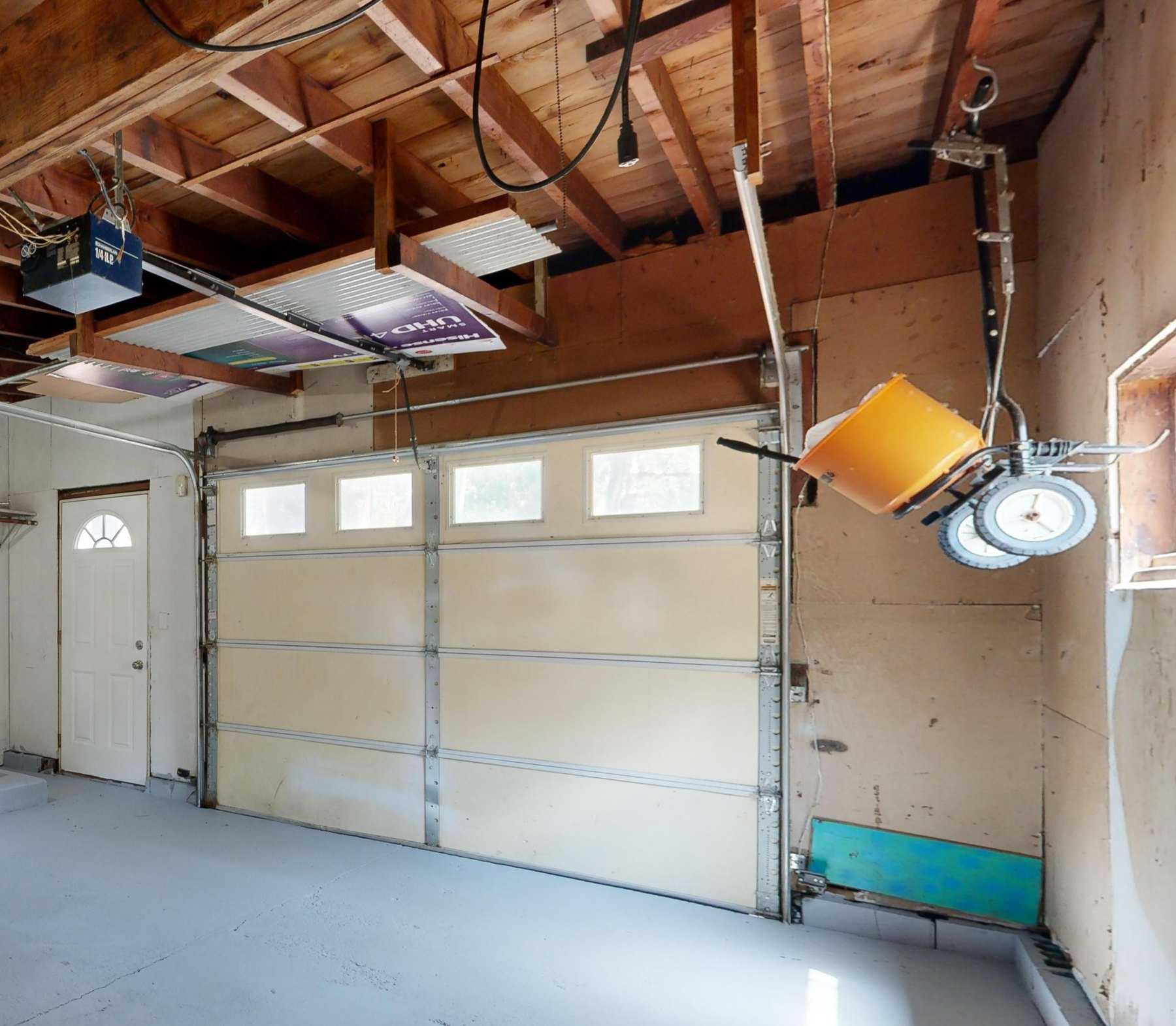
Garage door off track
A door is “off track” when one or more rollers have come out of the metal track, so the door hangs crooked, jams partway or sits at an angle in the opening.
Common causes: the door was hit (often by a car backing out); a lift cable broke or came off its drum, so one side dropped; worn or broken rollers; tracks that have worked loose from their wall brackets or are out of alignment; or debris and lack of maintenance. Door maker Amarr lists loose tracks, misalignment, dirt and lack of lubrication among the usual culprits.
Why not to “run it” or force it back: an off-track door may be hanging partly on cables connected to the springs. Running the opener or prying the door can bend the tracks and door sections, which turns a track-and-roller repair into a section or door replacement.
What a proper repair includes: securing the door, finding why it left the track (cable, roller, bracket or impact), straightening or replacing bent track, replacing damaged rollers and hinges, re-tensioning or replacing cables on both sides, then a balance test and safety-reversal test.
Broken or frayed garage door cables
Lift cables run from the bottom brackets at each corner of the door up to cable drums on the spring shaft. They carry the door’s weight as the springs lift it.
- Signs: a cable hanging loose or slack; frayed or broken strands; a cable that has jumped off its drum; the door rising unevenly or hanging lower on one side.
- Why it’s not DIY: cables, drums and bottom brackets are all connected to the spring system and under tension. Genie and DASMA both warn homeowners not to remove or adjust them.
- What a proper repair includes: replacing cables in pairs (both sides wear together), checking the drums and bottom brackets, checking the springs (a broken spring often throws a cable), and re-balancing the door.
Lift cables (2), bottom brackets (3), rollers and tracks (4): the parts involved in most off-track and cable repairs.
- Torsion springs. Wound springs on a steel tube above the door. They counterbalance the door’s weight and are under high tension.
- Cable drums and lift cables. Drums at each end of the tube wind the cables that lift the door. The cables are under the same tension.
- Bottom brackets. Where the lift cables attach to the bottom of the door. They are under tension — not a DIY adjustment point.
- Rollers and tracks. Rollers on each section ride in the vertical and horizontal tracks.
- Opener and rail. The motor unit moves a trolley along the rail; the door arm connects it to the top section.
- Emergency release. A red handle that disconnects the door from the opener so it can be moved by hand.
- Safety sensors (photo eyes). Mounted low on each track. If the invisible beam is blocked while closing, the opener must reverse.
- Wall control. The push button inside the garage. Many have a lock or vacation mode that disables remotes.
Worn rollers, hinges and tracks
Rollers ride in the tracks at each door section; hinges join the sections. When they wear, the door gets noisy, jerky and harder on the opener, and badly worn rollers can let the door leave the track.
- Signs: grinding, squealing or rattling; wobbly or cracked rollers; rollers that bind in the track; hinges that are cracked or loose.
- Steel vs. nylon rollers: nylon rollers are quieter. Door makers say to lubricate metal hinges and metal rollers with unsealed bearings, but not the bearings of nylon rollers.
- Safe homeowner care: lubricate metal hinges and metal rollers as your door’s manual describes. Never loosen or remove the bottom roller brackets: they’re attached to the lift cables and are under tension.
- Repair: replacing a worn roller set and cracked hinges is usually a modest repair, often worth doing when a technician is already there for springs or cables.
Garage door won’t open
Work through these in order, without touching springs or cables:
- Power: is the opener plugged in with its light working? Check the breaker and, if the outlet is a GFCI type, press reset.
- Lock mode: if remotes and the keypad don’t work but the wall button does, the wall control’s lock or vacation mode may be on.
- Emergency release: if the motor runs but the door doesn’t move, the trolley may be disconnected.
- Springs: look up. A gap in a torsion spring means a broken spring — see the spring repair guide. A door that won’t lift with a running motor is a classic broken-spring symptom.
- Tracks and cables: a door that’s crooked or off track won’t open safely. Stop and call a professional.
Garage door won’t close
A door that starts down and reverses, often with a blinking opener light, almost always points to the safety sensors. Openers made since 1993 must have this kind of external entrapment protection under federal rules. A misaligned bracket, a cobweb, a bin in the beam path or low sun shining into a receiver can all do it. If the door reverses right after touching the floor, the close-limit or force setting may need adjustment, which a technician should set and re-test. The opener repair guide walks through the sensor checks.
Troubleshooting by symptom
“Safe to check” means a visual check or a simple step that doesn’t involve spring-loaded parts.
| Symptom | Most likely causes | Safe to check yourself |
|---|---|---|
| Door crooked, jerks, or one side hangs lower | Loose or broken cable, door off track, broken spring | Visual check only. Stop using the door. |
| Rollers popped out of the track | Door off track (impact, worn rollers, loose track, broken cable) | Don’t operate it. Keep people and cars clear. |
| Cable hanging loose or frayed | Cable worn, off its drum, or a spring broke | Look only. Don’t touch the cable or bottom bracket. |
| Loud bang, then the door won’t lift | Broken spring | Look for a gap in the spring coil above the door. |
| Door starts down, then reverses; light blinks | Safety sensors blocked, misaligned or in direct sun | Clear the beam path, wipe lenses, check both sensor lights |
| Opener runs but door doesn’t move | Trolley disconnected, worn drive gear, or broken spring | Check whether the red release was pulled; check the springs |
| Grinding, squealing or rattling | Dry hinges or metal rollers, worn rollers, loose hardware | Lubricate metal hinges and unsealed metal-roller bearings |
| Door feels heavy when lifted by hand | Springs weak or broken | Stop lifting it; have the balance checked |
Other common repairs
- Bottom seal and weatherstripping: a worn or torn bottom seal lets in water, pests and hot air; replacing it is a small job, often done with other repairs.
- Damaged panels or sections: a dented or cracked section can sometimes be replaced on its own if the same door model is still available; otherwise it becomes a repair-or-replace decision.
- Tune-ups: lubrication of metal parts, hardware tightening, a balance check and a safety-reversal test. Useful when the door is noisy or hasn’t been looked at in years.
- Springs and openers have their own guides: spring repair and opener repair.
What affects garage door repair prices
- Which part failed — rollers and hinges cost less than cables, which cost less than springs or bent track and sections.
- Door size and weight — a double door, an 8-foot-tall door or a heavily insulated or wood-look door needs heavier hardware.
- Whether damage spread — a door that was run or forced while off track often needs track or section work too.
- Parts quality — sealed-bearing nylon rollers, heavier cables and higher-cycle springs cost more and usually last longer.
- The trip or diagnostic fee — and whether it’s applied to the repair.
Repair costs
These ranges come from national cost guides that publish their dates, and include parts and labor unless noted. They are budgeting context, not quotes, and two reputable guides disagree noticeably, which is exactly why a written quote matters.
| Job | Fixr (2025)[1] | This Old House (2026)[2] | What moves the price |
|---|---|---|---|
| Typical repair | $150–$350 | $98–$860 | Which part failed, door size and weight, parts quality |
| Cable replacement | $100–$200 | — | Usually both sides; often done with spring work |
| Door off track | $100–$300 | — | Whether tracks or sections were bent |
| Roller replacement | $100–$150 | — | Steel vs. nylon rollers; number replaced |
| Service call or diagnostic visit (no repair) | $50–$75 | $50–$75 | Often credited if you go ahead with the repair; ask |
Published garage door repair costs (national cost guides). National figures for budgeting, shown side by side by source. They are not Fulshear or Houston-area averages, and not prices from the independent company that receives your request, which quotes after seeing your door.
- [1] Fixr — Garage door repair cost (updated Jan. 31, 2025). Figures checked Oct 28, 2026.
- [2] This Old House — Garage door repair cost (updated May 29, 2026). Figures checked Oct 28, 2026.
Repair or replace?
Most single-part failures — a cable, roller set, hinge, spring or opener — are repairs, and a sound door doesn’t need replacing because one part broke. Replacement starts to make sense when sections are bent, cracked or rusted through; when the door has been hit hard; when parts for an older door are hard to get; or when you want better insulation, quieter operation or a different look. If a technician recommends replacing a whole door for what sounds like a cable or track problem, ask them to show you the damage and consider a second quote. The installation and replacement guide covers what a new door involves.
Monthly checks that prevent bigger repairs
The International Door Association and DASMA suggest a few quick monthly checks:
- Look at the springs, cables, rollers and pulleys for wear, gaps or fraying. Look only.
- Reversal test: lay a 2×4 flat on the floor in the door’s path and close the door. It should reverse after touching the board. If it doesn’t, stop using the opener until it’s serviced.
- Sensor test: start closing the door and pass an object through the sensor beam. The door should reverse.
- Balance test (if comfortable): with the door closed, pull the release and lift the door about halfway by hand. It should roughly stay put. If it slams down or shoots up, the springs need adjustment by a technician. Reconnect the opener afterwards.
Choosing a garage door company
Whether you request service here or find a company yourself, these questions help you compare providers fairly:
- What’s the trip or diagnostic fee, and is it applied to the repair?
- Can I have the full price in writing before you start? A good technician explains what failed and why.
- What parts are you using? For rollers, steel or nylon and sealed bearings; for springs, the rated cycle life.
- Will you replace the cables (or springs) on both sides? Both sides have had the same wear.
- What’s the warranty on parts and labor, in writing? “Lifetime” means little without written terms.
- Are you insured, and will your own employee do the work? Ask for proof of insurance for larger jobs.
- Does the job need electrical work? Adding an outlet is electrical work that Texas licenses; you can check an electrician on the TDLR license search.
Be cautious of prices that change after arrival, pressure to decide on the spot, or quotes that bundle parts you didn’t ask about without explaining why.
Frequently asked questions
Can I put a garage door back on track myself?
It isn't recommended. An off-track door is often hanging partly on cables that are connected to the springs, and the door itself is heavy. DASMA's safety guidance says to stop using the door and call a trained technician when rollers don't stay in the track. Forcing the door can bend tracks and sections and make the repair larger.
Can I repair a garage door cable myself?
No. Lift cables, bottom brackets and drums are connected to the springs and are under high tension. DASMA and opener manufacturers advise homeowners not to remove, repair or adjust springs or cables. A loose or frayed cable is a job for a trained technician, who will usually check both sides.
Is it safe to open my garage door by hand if the opener isn't working?
Only if the springs and cables are intact. With a working spring system a door should feel manageable and stay put when you let go partway up. If a spring is broken or a cable is loose, don't lift the door: the weight is no longer counterbalanced and it can drop. Use the red emergency release only with the door closed when possible.
Why does my garage door go down and then back up?
Usually the safety sensors. If the beam between the two sensors near the floor is blocked, misaligned or blinded by direct sun, the opener reverses. If the door reverses right after touching the floor, the opener's close-limit or force setting may need adjustment. See the opener repair guide.
How much does garage door repair cost?
National cost guides list, for parts and labor: $150–$350 for a typical repair, $100–$200 to replace cables, $100–$300 for an off-track door and $100–$150 for rollers (Fixr, 2025). This Old House (2026) shows a much wider $98–$860 range across repair types. These are budgeting figures, not Fulshear prices or quotes from the company that receives your request. Ask for the service-call fee and the repair price in writing before work starts.
Does Texas license garage door technicians?
We haven't found a statewide Texas license specifically for garage door repair or installation. That makes your own checks more important: ask about insurance, get written quotes and warranties, and read recent reviews. Electrical work, such as adding a new outlet for an opener, is licensed in Texas; you can verify an electrician on the TDLR license search.
Sources and further reading
- DASMA Technical Data Sheet #167 — Garage door safety and maintenance
- U.S. Consumer Product Safety Commission — Garage door operator safety (Publication 523)
- International Door Association — Garage door care and maintenance
- Genie — Maintaining your garage door
- Genie — Opener FAQs (safety sensors)
- Clopay — Do I have a broken garage door spring?
- Amarr — Everything you need to know about garage door repair
- Fixr — Garage door repair cost (updated Jan. 31, 2025)
- This Old House — Garage door repair cost (updated May 29, 2026)
- U.S. Census Bureau, American Community Survey 2020–2024 (via Census Reporter) — Fulshear, TX
- Texas Department of Licensing and Regulation — License search
Page last reviewed . This page is general information, not a substitute for an on-site inspection by a qualified technician. Spotted an error? Tell us.